Model evaluation
Same perfect score. Half the bill.
GLM 5.3 Flash, DeepSeek V4.1 Flash and Muse Ember ran the same 18 tasks, three tries each. GLM and DeepSeek never missed a try. DeepSeek’s bill came in at half of GLM’s. Ember passed 52 of 54 once six tries that first failed in setup were rerun.
Three models ran the same small test: 18 tasks in each of three groups, every task tried three times, 54 tries per model. The groups are code repair (CR4), multi step execution (AE1) and long horizon work (LH1). Every model was given the same tasks and scored the same way.
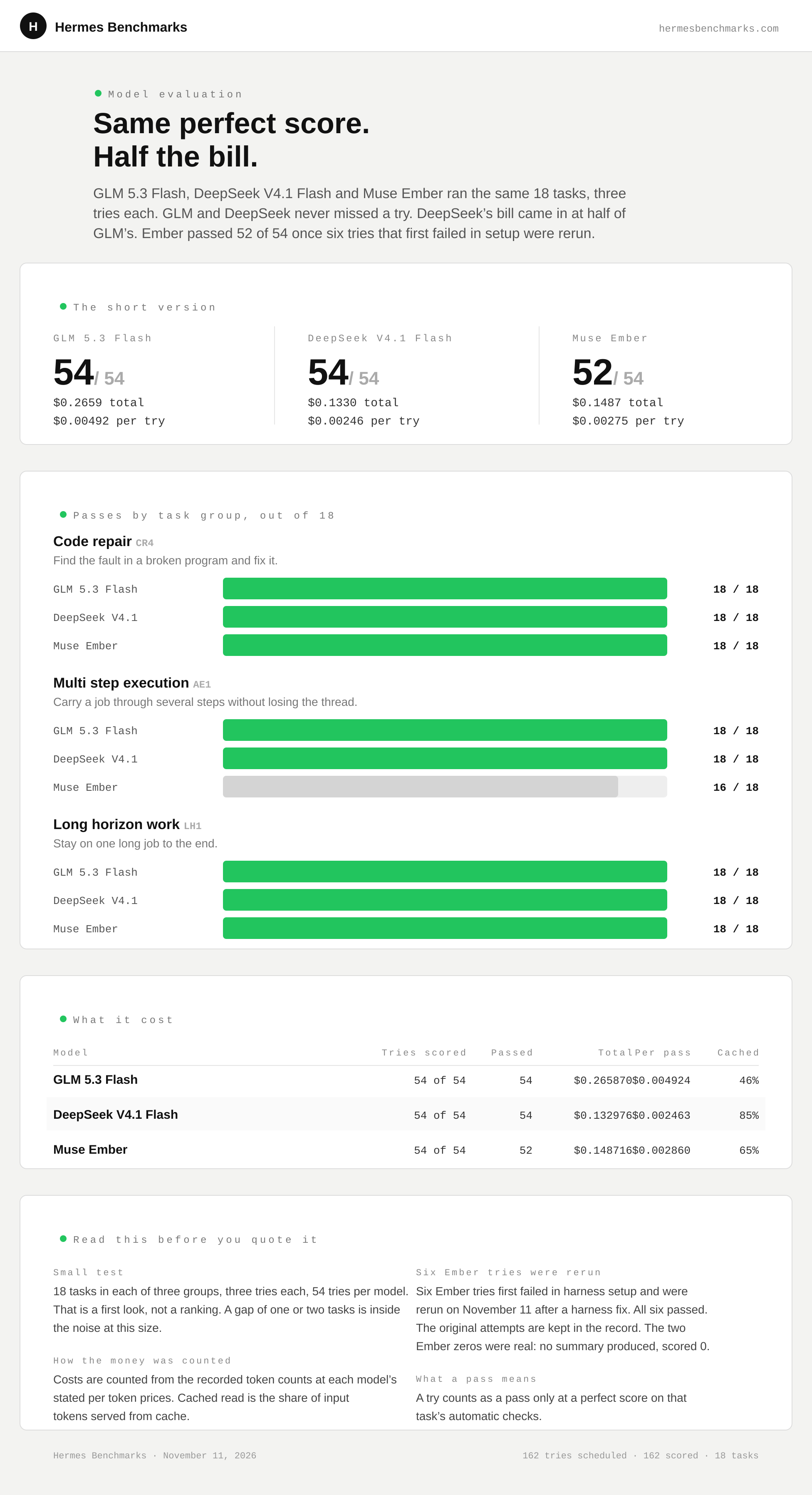
GLM 5.3 Flash and DeepSeek V4.1 Flash both passed every try they were given: 54 of 54. All 18 tasks passed all three tries for both. On code repair that is 18 of 18, on multi step execution 18 of 18, and on long horizon work 18 of 18.
Muse Ember passed 52 of its 54 tries. On code repair it also went 18 of 18. On multi step execution it passed 16 of 18, and those two misses were real: the model produced no summary and scored 0. On long horizon work it went 18 of 18, after the rerun described below. Across the whole test, 16 of the 18 tasks passed all three tries.
The money is where GLM and DeepSeek part company. The same 54 passes cost $0.265870 on GLM 5.3 Flash and $0.132976 on DeepSeek V4.1 Flash. That is $0.004924 per try against $0.002463, so DeepSeek delivered an identical score sheet for about half the bill. Ember’s total was $0.148716 for its 54 tries, which is $0.002754 per try and $0.002860 per pass, above DeepSeek’s $0.002463 per pass and well below GLM’s $0.004924.
Token counts explain part of the gap. GLM 5.3 Flash recorded 2,438,720 input tokens, 68,755 output tokens and 1,119,296 cached reads, about 46 percent of its input served from cache. DeepSeek V4.1 Flash recorded 3,176,476 input, 92,590 output and 2,714,624 cached reads, about 85 percent of input. Muse Ember recorded 2,446,321 input, 111,157 output and 1,578,064 cached reads, about 65 percent.
Six Ember tries first failed in harness setup and were rerun on November 11, 2026, after a harness fix. The setup failure hit the last two long horizon tasks, all three tries each, before any model call, so it was a harness failure and not a model failure. All six tries passed on the rerun, and the numbers above include them. The original failed attempts are kept in the record. The two Ember zeros on multi step execution were real.
None of this settles a ranking. Eighteen tasks per group with three tries each is a small test, and a gap of one or two tasks sits inside the noise at that size. Read the numbers as a first look. What they do support is narrower and more useful: on this test, a model that costs twice as much did not score any better.
Same tasks, same scoring, costs counted from the recorded token counts at the stated per token prices. Three task groups of 18 tasks each, three tries per task, 54 tries per model. A try counts as a pass only at a perfect score on that task’s automatic checks. Cached read is the share of input tokens served from cache. The figures behind this page are kept in the site repository under data/articles/three-models-one-test/.
Sources
- Run records: Hermes Benchmarks cost batch v2, November 11, 2026; 162 scheduled cells, 162 scored, batch record hash fb83cbd38c64a2312d06e4e194a5270ba36ed964491aedf55704629e817501d1, Ember rerun addendum hash a0a02294633b617f646c5f7d9a0d376627f731978fd40d244ab157b2f8b2a27a.
Comments
Loading comments…